
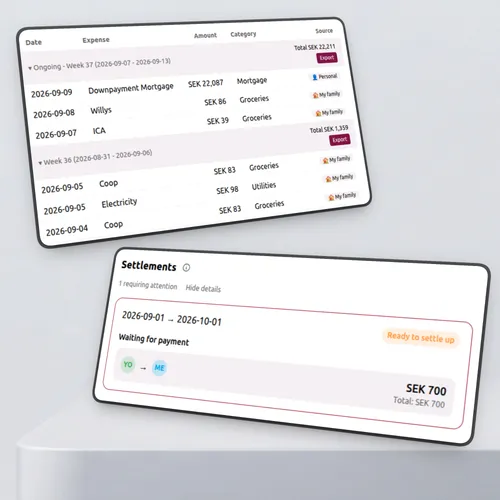
Assign bills to each partner
One partner handles the rent and utilities while the other takes care of groceries or other recurring costs. Agree on how to account for differences in the amounts paid.
Get household bills organized, agree on who handles each payment, and establish a simple routine for keeping shared expenses up to date.

Start with the household
Before organizing payments, agree on which costs belong to your shared household and which remain each person's responsibility.
List recurring costs such as rent or mortgage payments, electricity, water, internet, and household insurance. Record the due date and how each bill is paid.
Decide how you will handle groceries, cleaning supplies, childcare, and other purchases used by the household. These costs may vary from week to week.
Agree on how to handle personal subscriptions, hobbies, gifts, travel, car expenses, and larger purchases. If a cost benefits only one partner, do not assume it is automatically a shared bill.
There is no need for both partners to make every payment. The important thing is that you both know who is responsible and how shared costs are accounted for.
One partner handles the rent and utilities while the other takes care of groceries or other recurring costs. Agree on how to account for differences in the amounts paid.
If it suits your financial setup, both partners can contribute money to an account reserved for household bills. Use it only for the costs you have agreed to cover together.
Each partner can keep their own bank account and pay particular bills directly. Review the payments together and settle any outstanding amount on an agreed schedule.
These are ways to organize payments, not rules for deciding each partner's contribution. If you have not agreed on the amounts yet, use the contribution guides below.
Keep a single list of recurring bills so you can see what is due, who handles it, and whether payment has been completed.
Rent
Due at the start of the month
Partner A
Check due date
Utilities
Check each statement
Partner B
Check amount
Internet
Recurring payment
Partner A
Verify payment
Groceries
Review household spending
Both partners
Review monthly
This is an illustrative assignment, not a recommended division. Replace the responsibilities and timing with the arrangement that works for your household.
Check upcoming payments
Review due dates, expected amounts, and any bills that have changed.
Confirm what was paid
Check statements and receipts rather than assuming a scheduled payment went through.
Resolve anything outstanding
Follow up on missed payments, unexpected charges, or amounts that need to be settled between you.
Update the list
Record changes to bill amounts, payment responsibilities, or due dates before the next month.
Deciding who pays a particular bill is different from deciding how much each partner should contribute overall. If one person handles more direct payments, that does not automatically mean they should bear a larger share of the household costs.
Use the dedicated guides to choose a contribution arrangement and calculate the amounts. Keep this page as your practical reference for organizing and maintaining the payment routine.
Continue with the page that matches the task you need to complete.
FAQs
Answers to common questions about organizing, paying, and managing shared household bills.
List your recurring household expenses, including housing, utilities, internet, groceries, and subscriptions. Record each bill’s due date, amount, payment method, and responsible person. Include irregular expenses so they are not overlooked when planning your household spending. Agree on which costs are shared and review the list when your circumstances change.
You can keep your individual bank accounts while agreeing on which expenses to share, how those expenses will be funded, and when payments will be settled. The arrangement should make responsibilities clear without requiring you to merge all your income. You can each pay bills directly or contribute to a dedicated account for household costs.
An equal split means each partner contributes the same amount, while a proportional split bases contributions on an agreed factor such as income. You can also agree on another arrangement that suits your circumstances. Choose the method together, consider what each person can reasonably afford, and apply the agreement consistently to the expenses you have decided to share.
Start with the total shared expenses for the period and the contribution method you have agreed on. Calculate each partner’s expected contribution, then compare it with payments already made to determine whether either person needs to transfer money to the other. Remember to account for any reimbursements or settlements already completed.
Record the shared bills each person actually paid over the same period. Compare those payments with each partner’s agreed contribution rather than assuming that paying more individual bills means contributing more overall. Account for any transfers between you before working out the remaining difference.
A joint account can simplify shared bill payments, while separate accounts allow each partner to retain individual control over their money. You can also combine approaches by keeping personal accounts and using a dedicated account for agreed household expenses. Decide how contributions, withdrawals, and outstanding balances will be handled before choosing an arrangement.
Married couples can agree on how to fund household expenses while maintaining separate day-to-day accounts. Consider how you will handle recurring bills, savings goals, larger purchases, and changes in income. The legal and financial implications of separate accounts can vary depending on where you live, so seek local advice if you have questions about ownership or marital property.
Check the updated amount or payment status, identify whether action is needed before the due date, and agree who will handle it. Update your shared bill list, account for any late fees or additional payments, and review the arrangement if the same issue keeps recurring. If a bill increase affects your monthly plan, adjust your household budget and agree how to cover the difference.
Start by separating essential household costs from personal expenses and discussing which purchases benefit both of you. Some expenses, such as housing and utilities, may be straightforward to share, while subscriptions, transport, and family costs may need more discussion. Agree on clear categories and exceptions before calculating contributions, and revisit the arrangement if either partner’s needs change.
Review payment status and outstanding balances monthly. Revisit the wider arrangement when you move, change providers, take on new expenses, or experience a significant change in income or household responsibilities. Update payment instructions and reminders whenever you agree to a change.
Once you have agreed on how to handle household payments, calculate the contributions that will fund them.