
Keep your finances separate. Manage your household together.
You do not need a joint bank account to build a shared financial life. Keep your personal money, accounts, spending, and savings separate while managing the expenses and budget you share as a couple.
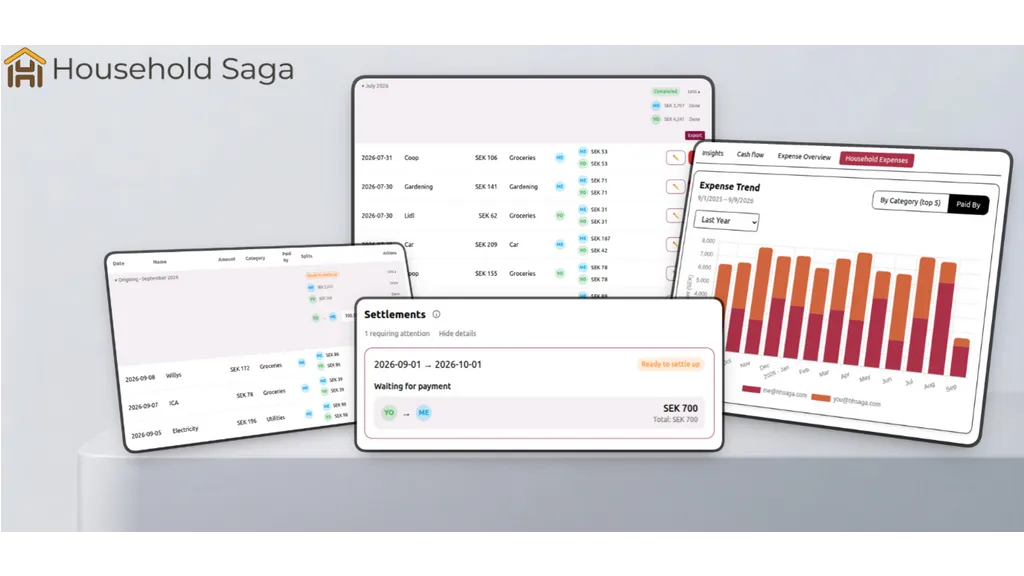
Separate does not mean disconnected
You can share a household without combining everything.
Many couples want both financial independence and a clear way to manage the costs of living together. The choice does not have to be completely joint finances or completely separate finances.
Keep your personal finances personal
Your salary, savings, personal spending, individual accounts, and personal financial goals can remain yours.
Create a shared financial layer
Bring the expenses and commitments you actually share into one household: rent, groceries, utilities, subscriptions, travel, childcare, and more.
See the household separately
Your household can have its own expenses, budget, contributions, balances, and settlements without requiring every personal transaction to become shared.
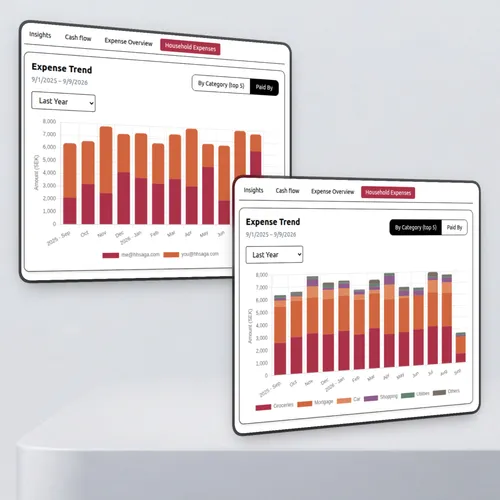
The separate + shared model
Keep your money yours.Share what matters.
You don't need to combine your finances to manage a household together. Keep your personal money private while sharing the expenses, plans, and goals that belong to both of you.
Partner A
Your personal money
What belongs to you stays yours. No need to merge accounts or expose every personal transaction.
Partner B
Your personal money
Keep your own financial life intact while still contributing to the household you share.
Shared household
One shared view of the money that belongs to both of you.
Your household doesn't need access to everything. Just the things you're actually managing together.
Two people. One household view.
The point isn't to combine everything. It's to make the shared part simple.
A shared layer for your shared life
Everything you share. Nothing you do not.
Household Saga gives couples a place to manage shared finances without turning personal finances into household finances.
Keep separate bank accounts
You do not need to merge your bank accounts or create one giant pool of money to manage your household together.
Track shared expenses
Record the expenses that belong to both of you and keep personal purchases outside the household.
Set contribution rules
Split shared expenses 50/50, proportionally, or according to another arrangement that works for your household.
See who paid
Know which partner paid for each shared expense and how those payments affect the household balance.
Manage a household budget
Create and track budgets for the expenses you share without combining your personal budgets.
Settle when you choose
Reconcile shared expenses weekly, monthly, yearly, or according to whatever rhythm works for you.
The problem with going completely separate
Separate finances can become a spreadsheet problem.
When everything stays separate, shared expenses can end up scattered across two bank accounts, receipts, notes, messages, and memory.
Who paid the rent?
One partner pays the rent while the other covers groceries, utilities, and subscriptions. Without a shared view, the household balance can become difficult to reconstruct.
Who paid more this month?
The total household spending may be clear, but comparing each partner's actual payments with their agreed contribution takes time.
What counts as shared?
Not every transaction belongs to the household. Without clear boundaries, personal spending and shared spending can easily become mixed together.
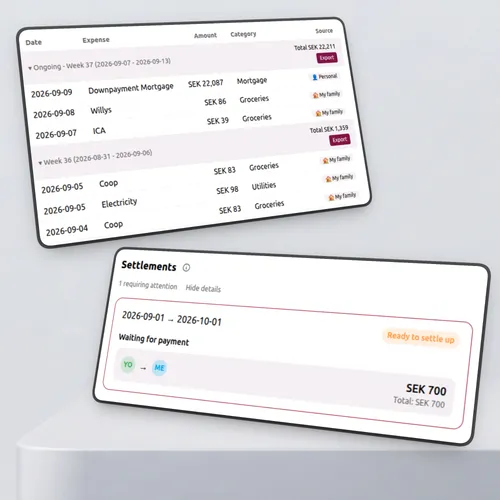
The problem with combining everything
A joint account is not the only way to manage money together.
A completely combined financial system can work for some couples. But it is not the only model. You may want shared visibility and shared responsibility without making every part of your financial life joint.
Personal spending can stay personal
You may want freedom over your own discretionary spending without every purchase becoming a household transaction.
Personal savings can stay personal
Individual savings goals, investments, gifts, hobbies, or other personal financial priorities do not necessarily need to become shared household expenses.
Shared responsibilities can still be visible
Keeping personal finances separate does not mean hiding the household. Shared expenses, budgets, contributions, balances, and settlements can remain visible to both partners.
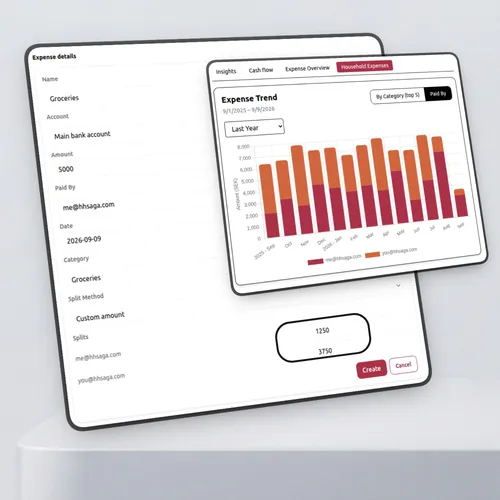
Three ways couples can organize money
Completely separate, completely joint, or somewhere in between
Couples use different financial arrangements. Household Saga is designed around the middle model: personal finances can remain personal while shared household finances are managed together.
Completely separate
Each person manages their own income and expenses independently. Shared costs may be divided manually when they arise.
Completely joint
Most or all income, spending, accounts, and financial decisions are combined into one shared financial system.
Separate + shared
Personal finances remain separate while the couple creates a shared layer for household expenses, budgets, balances, and settlements.
The middle ground
What belongs in the shared household?
The answer is different for every couple. The useful principle is simple: share the things you agree to manage together and keep the rest personal.
Often shared
- Rent or mortgage
- Electricity and other utilities
- Groceries and household supplies
- Internet and shared subscriptions
- Childcare and household costs
- Shared transportation
- Holidays and shared travel
- Other agreed household commitments
Often personal
- Personal shopping
- Individual hobbies
- Personal subscriptions
- Gifts
- Individual savings goals
- Personal investments
- Individual debt payments
- Other expenses you choose to keep separate
Different incomes are not a problem
You can keep finances separate even when you earn different amounts.
Separate finances do not require equal incomes. What matters is agreeing on how the shared household should be funded.
50/50 contributions
Both partners contribute the same amount to the household, regardless of their individual income.
Proportional contributions
Each partner contributes according to their share of the combined income. The higher earner contributes a larger amount while both contribute according to the same income ratio.
Another arrangement
You can also use fixed contributions, different splits for different expenses, or a model that considers other household contributions.
It is not only about income
Household contributions can include more than money.
One partner may earn more while the other contributes more time to childcare, cooking, cleaning, planning, administration, or other unpaid household responsibilities.
Paid work
Income can be one factor in deciding how shared expenses should be funded, especially when partners have different earnings.
Unpaid household work
Cooking, cleaning, shopping, maintenance, and other household tasks take time even though they do not appear as income.
Caregiving and mental load
Childcare, dependent care, planning, scheduling, appointments, bills, and household administration can also affect how partners contribute to the household.
Separate accounts, shared visibility
What each partner can see and manage
The goal is not to expose every personal transaction. It is to create a shared view of the financial responsibilities you have actually agreed to share.
Your personal finances
Your individual income, spending, savings, accounts, and personal financial goals can remain outside the household.
Your shared household
Both partners can work from the same household view of shared expenses, budgets, contributions, and financial commitments.
Your household balance
Shared payments can be compared against agreed contributions so you can understand what needs to be settled.
How the household works
From two financial lives to one shared household
Household Saga does not require you to turn your personal finances into a joint account. Instead, it gives your shared financial responsibilities their own place.
Personal money stays personal
Each partner continues to manage their own personal income, spending, accounts, and financial goals.
Shared expenses enter the household
Add the expenses you have agreed to share and record which partner paid for them.
The household tracks the difference
The household balance reflects each partner's share and actual payments so you can see where you stand.
How to manage separate finances together
Decide what is shared
Agree which expenses and financial commitments belong to the household and which remain personal.
Choose how you contribute
Decide whether shared expenses are split 50/50, proportionally to income, through fixed contributions, or another arrangement.
Create your household
Bring your shared expenses and household budget into one place without merging your personal finances.
Record who paid
Track shared expenses as they happen so the household balance reflects reality rather than memory.
Settle when it makes sense
Reconcile the balance on a schedule that works for your household instead of sending money back and forth after every purchase.
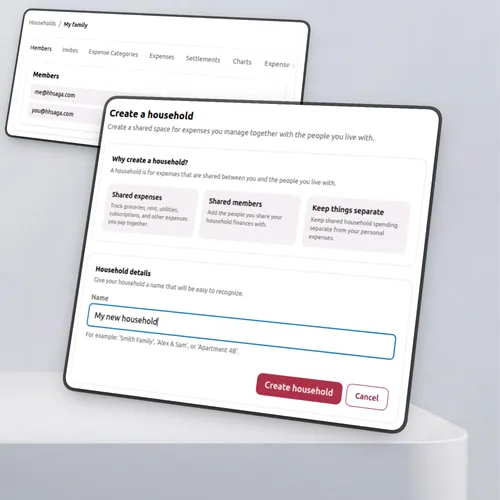
A household is more than a collection of bills
Manage the shared layer over time
The value of a shared household is not only knowing who owes €37 for dinner. It is having one place for the recurring financial responsibilities that come with building a life together.
Recurring expenses
Keep track of regular household costs instead of recreating the same calculations every month.
Household budgets
Plan spending for the household while keeping your personal budgets and financial goals separate.
Settlements and balances
See the cumulative difference between what each partner has paid and what each partner is responsible for.
This model can work in many situations
Separate finances are not only for one type of couple
The separate + shared approach can be adapted to different incomes, relationships, living arrangements, and household responsibilities.
Different incomes
Keep salaries separate while contributing to shared costs using an agreed 50/50, proportional, or custom arrangement.
Long-term couples
Maintain personal financial independence while building a shared system for the household you have created together.
Couples living together
Create a shared financial layer for rent, utilities, groceries, subscriptions, and the everyday costs of living together.
Separate does not mean secret
Shared finances should be clear even when personal finances are private.
There is an important difference between financial privacy and financial confusion. You can keep personal purchases and accounts personal while making household responsibilities visible to both partners.
Agree on the boundaries
Decide together which information belongs in the shared household and which information remains personal.
Make shared commitments visible
Both partners should be able to understand the household expenses, budget, contribution arrangement, and outstanding balance they share.
Review the system together
As your relationship, income, living situation, or responsibilities change, revisit what belongs in the shared household.
The Household Saga approach
You are building a household, not necessarily a joint bank account.
Household Saga gives the shared part of your financial life its own space. Your personal finances can remain yours while the expenses, budgets, balances, and responsibilities you share become easier to manage together.
FAQs
Separate finances as a couple: questions
You can keep your personal finances separate while managing shared household money together.
Can couples keep separate bank accounts and still manage money together?
Yes. Couples can keep their personal bank accounts and finances separate while creating a shared system for household expenses, budgets, contributions, balances, and settlements.
Do couples have to combine their finances after getting married?
No. Couples can choose how they want to organize their finances. Some combine most finances, some keep them separate, and others use a combination of personal finances and shared household finances.
Can we keep our salaries separate?
Yes. Your personal income can remain part of your personal finances while you and your partner agree on how to fund shared household expenses.
How do couples split bills with separate bank accounts?
First decide which bills are shared and how they should be divided. Then track which partner pays each expense and reconcile the household balance according to your agreed contribution method.
How should couples split expenses when incomes are different?
One option is proportional splitting, where each partner contributes according to their share of combined income. Couples can also choose 50/50, fixed contributions, or another arrangement.
Should couples split expenses 50/50?
Some couples do. Others split shared expenses proportionally to income or use another arrangement. A 50/50 split means each partner contributes the same amount; it does not mean every couple needs to use that method.
What is proportional expense splitting?
Proportional splitting divides shared expenses according to each partner's share of combined income. For example, if one partner earns 60% of the combined income, they contribute 60% of the shared expenses.
Can one partner contribute more to shared expenses?
Yes. Couples can agree that one partner contributes more, whether because of income differences, household responsibilities, caregiving, or another reason that matters to them.
Does keeping finances separate mean we should split every bill individually?
No. You can maintain separate personal accounts while managing shared expenses as one household. Tracking shared expenses together can reduce the need to calculate every bill manually.
What should couples consider shared expenses?
Common shared expenses include housing, utilities, groceries, household supplies, shared subscriptions, childcare, transportation, travel, insurance, and other costs both partners agree belong to the household.
What expenses should stay separate?
Personal purchases, individual hobbies, gifts, personal subscriptions, individual savings goals, and other expenses can remain separate when that is what both partners agree to.
Can we have a shared household budget without sharing personal spending?
Yes. A shared household budget can focus only on the expenses and financial commitments you manage together. Personal spending can remain outside the household budget.
Can couples manage shared finances without a joint account?
Yes. A joint bank account is one possible way to manage shared money, but it is not required for tracking shared expenses, household budgets, partner contributions, or settlements.
What if one partner pays most of the bills?
Track who actually paid each shared expense and compare those payments with the agreed household contribution. The resulting balance can then be settled according to your arrangement.
What about household chores and caregiving?
Financial income is only one part of household contribution. Couples may also discuss unpaid work such as cooking, cleaning, caregiving, planning, administration, and other responsibilities when deciding how they want to organize shared finances.
What is the mental load in a household?
Mental load can include planning appointments, remembering bills, organizing schedules, arranging childcare, monitoring household tasks, and anticipating what needs to happen. Couples may consider it when discussing how household responsibilities are shared.
Can we keep our savings separate?
Yes. Personal savings can remain separate while you maintain a shared household budget and track the expenses you both agree to manage together.
Can couples keep separate finances after having children?
Yes. Couples can choose to maintain separate personal finances while creating shared arrangements for childcare, housing, groceries, education, insurance, and other household or family expenses.
How often should couples review their shared finances?
There is no universal schedule. You may want to review the arrangement when income, housing, employment, caregiving responsibilities, family circumstances, or household expenses change.
Is keeping finances separate better than combining them?
There is no single arrangement that works for every couple. Separate, joint, and hybrid approaches all involve different trade-offs. The important thing is to choose an arrangement both partners understand and agree to.
What is the difference between separate finances and financial independence?
Separate finances usually refers to keeping some or all accounts, income, spending, or savings separate. Financial independence can also refer more broadly to having autonomy over personal financial decisions. A couple can have separate finances while still managing shared responsibilities together.
Can Household Saga track personal and shared finances?
Household Saga is designed to let personal finances and shared household finances coexist. The household focuses on the expenses, budgets, contributions, balances, and settlements you choose to manage together.
Is Household Saga a joint bank account?
No. Household Saga is a financial management system for your household. It does not require you to turn your personal bank accounts into a single joint account.
Is Household Saga only for married couples?
No. Couples who live together or share financial responsibilities can use a household model regardless of whether they are married.
Keep your money yours. Build your household together.
Manage the expenses and financial responsibilities you share without forcing your entire financial life into one account.