50/50
EqualBoth partners contribute the same amount toward shared expenses.
Partner A
€0
Partner B
€0
Compare equal and income-based expense splitting, see what each approach means for your household, and calculate a contribution that works for both of you.
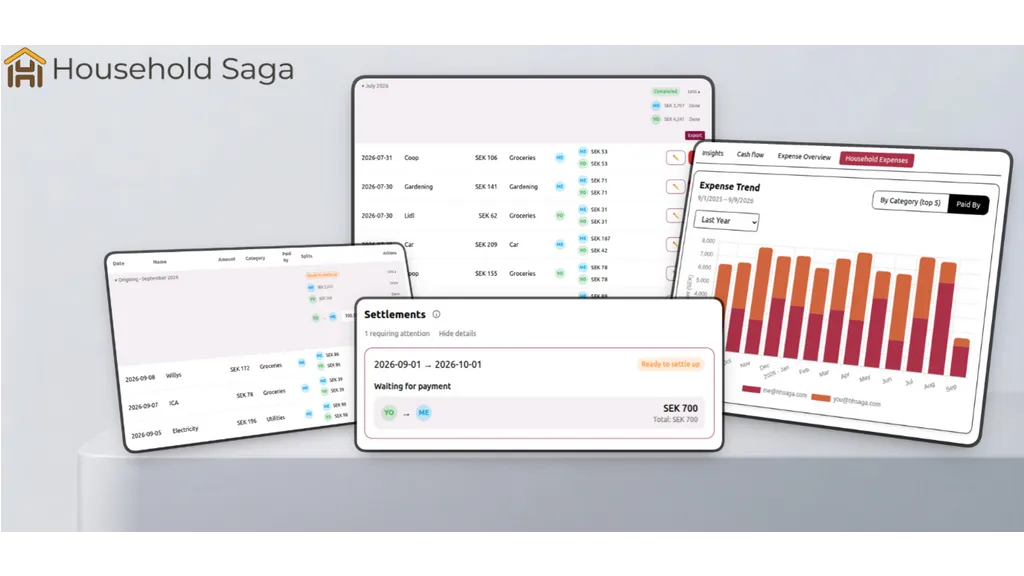
Compare your options
Enter your incomes and shared monthly expenses to compare an equal split with a split based on income. There is no universally correct formula, the useful part is seeing the numbers and deciding together.
Compare 50/50, proportional-to-income, and income-plus-household-work approaches. Include chores, childcare, caregiving, and mental load to see both partners' financial and unpaid contributions.
Use take-home income if you want to compare the money that actually reaches each partner's account.
Money isn't the only contribution to a household. Add recurring household work, caregiving, and mental load to make those contributions visible.
Cooking, cleaning, laundry, groceries, errands, home maintenance, etc.
Childcare, eldercare, or care for another dependent.
Planning, scheduling, remembering, organizing, researching, coordinating.
Cooking, cleaning, laundry, groceries, errands, home maintenance, etc.
Childcare, eldercare, or care for another dependent.
Planning, scheduling, remembering, organizing, researching, coordinating.
These values are only used to make unpaid contributions visible in the comparison. They are not a claim about what someone's work is "worth."
Move toward 0% to focus mostly on income. Move toward 100% to give unpaid work more influence.
Different couples use different definitions of a fair contribution. Compare the numbers rather than assuming one formula works for everyone.
Both partners contribute the same amount toward shared expenses.
Each partner pays according to their share of household income.
Combines income contribution with the unpaid work you've entered.
Enter the monthly amount each partner wants to contribute.
This shows the time and illustrative value of the unpaid work entered above.
Compare household work, caregiving, and mental load as weekly hours.
Paid income and unpaid household work are shown separately so you can see the full picture.
Monthly income
Monthly income
50/50 simply divides shared expenses equally. It does not take income or unpaid work into account.
Proportional to income divides expenses according to each partner's share of the combined household income.
Income + unpaid work combines the income contribution with the unpaid-work contribution. The slider lets you decide how strongly unpaid work should influence that model.
The monetary value assigned to unpaid work is an illustrative assumption. The calculator does not determine what either partner's work is objectively worth, and there is no universally correct way for couples to divide expenses.
Two common approaches
The difference is simple: 50/50 asks each partner to contribute the same amount, while proportional splitting asks each partner to contribute the same percentage of their income.
Each partner contributes the same amount toward shared expenses. If your shared monthly expenses are €2,000, each person contributes €1,000.
Each partner contributes according to their share of the combined income. If one partner earns 60% of the household income, they contribute 60% of the shared expenses.
At a glance
Both approaches can work. The main difference is whether each partner contributes the same amount or a share based on income.
The same amount
A share based on income
The euro contribution stays equal
The higher earner contributes more
No
Yes
Usually, unless you change it
Usually, unless you change it
You and your partner
You and your partner
50/50
A 50/50 split means both partners contribute the same euro amount to shared expenses. It is straightforward and easy to calculate, but the same contribution can represent very different portions of each person's income.
If the household spends €2,000, each partner contributes €1,000. There is no income calculation required.
When both partners have similar incomes and similar financial circumstances, an equal contribution may fit the way you want to organize shared expenses.
Recurring expenses such as rent, utilities, groceries, and subscriptions can be divided into equal contributions without recalculating the ratio every month.
Proportional splitting
An income-based split changes the contribution according to each partner's share of household income. The goal is not to make one method universally correct, it is to give couples another way to structure shared costs.
Add both partners' incomes and calculate what percentage of the combined income each person earns.
Use those percentages for the household expenses you have agreed to share.
A new job, reduced hours, parental leave, freelance income, or another major change can alter the household income ratio.
A simple example
Imagine one partner earns €3,000 per month and the other earns €2,000. Together they earn €5,000 and have €2,000 of shared monthly expenses.
Partner A contributes €1,000 and Partner B contributes €1,000. Both contribute the same euro amount.
Partner A earns 60% of the combined income, so they contribute €1,200. Partner B contributes €800.
The household still receives the same €2,000 contribution. Only the way that contribution is divided between the partners changes.
Different incomes
There are several ways to approach unequal incomes. The important question is not only how much each person earns, but also what you both consider a shared responsibility.
List the costs that belong to the household: rent or mortgage, utilities, groceries, insurance, subscriptions, transportation, childcare, and other agreed expenses.
Decide whether shared expenses will be divided equally, proportionally to income, through fixed contributions, or using another arrangement.
A shared household does not mean every purchase needs to be shared. Keep personal spending outside the calculation when that is how you and your partner want to organize your finances.
Income is not the only contribution
A couple's contribution to a household is not always financial. One partner may earn more while the other handles more cooking, cleaning, childcare, planning, administration, or other unpaid work.
Cooking, cleaning, laundry, shopping, maintenance, and other recurring household responsibilities take time even when they do not appear in a bank account.
Childcare and care for dependents can affect how much time and flexibility each partner has available for paid work and other responsibilities.
Planning appointments, remembering bills, organizing schedules, managing household tasks, and anticipating what needs to happen are also forms of household contribution.
Beyond income
A proportional split looks only at income. Real households can be more complicated, especially when one partner takes on more unpaid household work or caregiving.
Time spent caring for children or dependents can affect paid work, income, and financial flexibility.
Cleaning, cooking, laundry, shopping, planning, and other unpaid responsibilities are part of how many couples contribute to their household.
If you want to consider these contributions alongside income, see how our couple expense splitter approaches the broader household contribution question.
A practical way to decide
The right arrangement depends on your incomes, responsibilities, preferences, and how you want to think about shared money.
List what you share
Start with the expenses that genuinely belong to the household rather than trying to combine every personal purchase.
Compare the contribution methods
Calculate what each person would contribute using 50/50 and proportional-to-income splitting.
Talk about the result
Consider income, household work, caregiving, personal spending, savings goals, and the arrangement you both want.
Track what actually happens
Record shared expenses and who paid so you do not have to reconstruct the household balance at the end of every month.
Review when life changes
Your arrangement does not have to be permanent. Revisit the split when income, responsibilities, or household costs change.
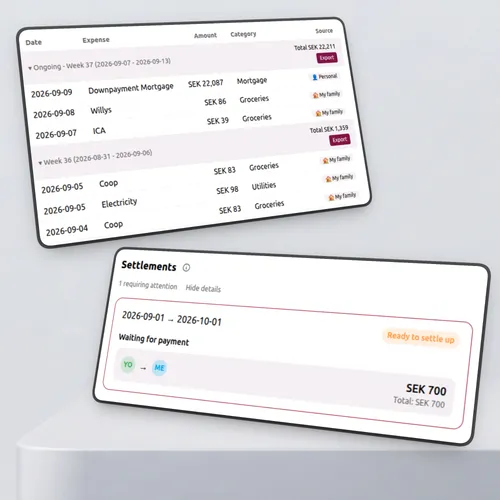
After you choose a split
Once you agree on a contribution method, the household still has groceries, rent, utilities, subscriptions, travel, unexpected expenses, and monthly settlements to manage.
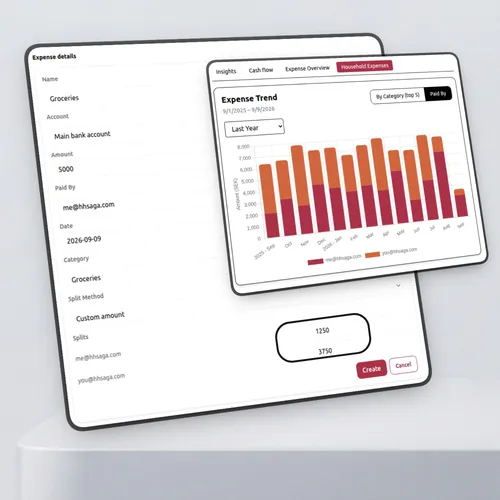
Keep track of the expenses that belong to both of you and record which partner paid for each one.
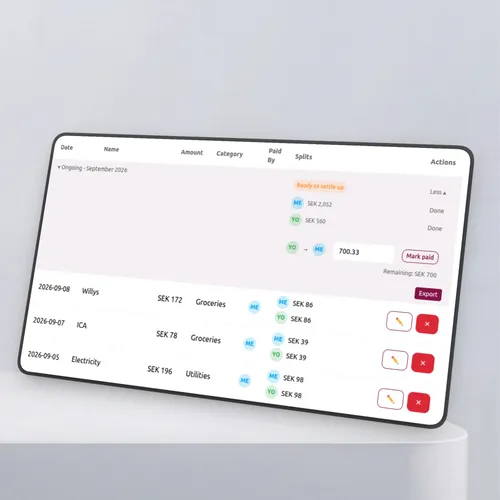
See how payments and agreed shares affect the balance between partners instead of calculating it from receipts and bank statements.
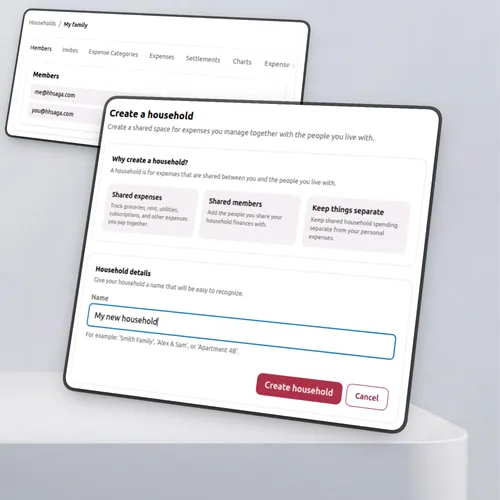
You can manage shared finances together while keeping your personal accounts, spending, and financial plans separate.
50/50 vs proportional: the bigger picture
Your contribution method answers one question: how much should each person contribute to shared costs? A household financial system has to handle everything that happens after that.
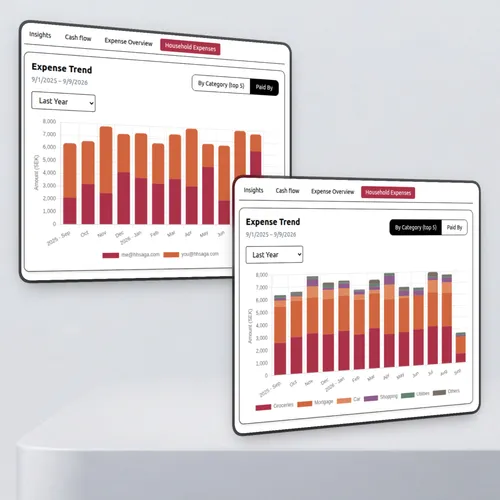
Track rent, groceries, utilities, subscriptions, travel, insurance, childcare, and other costs you agree belong to the household.
Keep personal income, savings, spending, accounts, and individual financial goals separate when that is the arrangement you prefer.
Track who paid, what each partner owes, and when you need to settle the difference.
One decision, many expenses
There is no requirement for every expense to follow the exact same split. Couples can agree on a general contribution method and make exceptions where their circumstances call for them.
Rent or mortgage may be treated as a core shared expense and divided according to your agreed household contribution.
Groceries, utilities, household supplies, and subscriptions can follow your regular household split.
Clothing, hobbies, gifts, individual subscriptions, and other personal purchases can remain outside the shared household.
FAQs
Answers to common questions about splitting bills and shared expenses as a couple.
A 50/50 split means both partners contribute the same amount to shared expenses. Some couples choose this approach, while others use income-based or another contribution method. The appropriate arrangement depends on the household and what both partners agree to.
Neither method is universally right for every couple. A 50/50 split divides the euro amount equally. A proportional split divides expenses according to each partner's share of combined income. Comparing both can help you decide which arrangement fits your circumstances.
One common approach is to split shared bills proportionally to income. For example, if one partner earns 60% of the combined income, they could contribute 60% of shared expenses. Couples can also use equal contributions, fixed amounts, or another arrangement.
Add both partners' incomes, calculate each person's percentage of the combined income, and apply those percentages to the shared expenses. For example, incomes of €3,000 and €2,000 produce a 60/40 income ratio.
A 50/50 split means each partner pays half of the shared expense. A €2,000 household expense would result in a €1,000 contribution from each partner.
No. Proportional splitting means each partner contributes according to their share of combined income. If one partner earns 60% and the other earns 40%, the shared expense is divided 60/40 rather than assigning the entire expense to one person.
Some couples split rent equally, while others divide it according to income or another arrangement. Consider your incomes, household responsibilities, housing arrangement, and what you both agree is appropriate.
Groceries can be treated as a shared household expense and split equally, proportionally, through fixed contributions, or another agreed method. The important step is deciding which purchases are actually shared.
They can be. An income-based split makes each partner's contribution proportional to their share of combined income. It is one option among several ways couples can organize shared expenses.
Income does not capture every household contribution. Cooking, cleaning, caregiving, planning, and other unpaid work can also matter when couples decide how to organize their finances.
A more flexible contribution model can include unpaid household work and caregiving as factors alongside income. The weighting is a household preference rather than an objective monetary value for chores.
Mental load can include remembering appointments, planning household tasks, organizing schedules, monitoring bills, arranging childcare, and anticipating what needs to happen. It can be part of a broader conversation about household contributions.
No. Couples can share household expenses while keeping personal bank accounts and personal finances separate. A shared household system can sit between completely separate finances and fully combined finances.
Yes. The contribution ratio determines how much each partner contributes to shared expenses; it does not require you to combine your personal bank accounts.
Common shared expenses include housing, utilities, groceries, household supplies, shared subscriptions, insurance, transportation, childcare, travel, and other costs you both agree belong to the household.
Not necessarily. Many couples keep personal purchases outside their shared expenses. You can define the household around the costs you actually agree to manage together.
There is no required schedule. You may want to review it when income changes, working hours change, caregiving responsibilities change, housing costs change, or another major household circumstance changes.
Yes. Couples can agree on different rules for different expenses. For example, some household costs could be split according to income while certain personal or discretionary expenses remain separate.
You can still use an agreed contribution method. Track who actually paid each shared expense and compare those payments with each person's agreed share when you settle the household balance.
An expense splitter helps calculate how a particular expense should be divided. A couple expense tracker is used to record shared expenses over time, see who paid, monitor the household balance, and manage ongoing contributions.
Start by deciding which expenses are shared. Then choose an arrangement such as 50/50, proportional to income, fixed contributions, or another method. Finally, track who actually paid each shared expense so you can reconcile the difference.
A proportional-to-income split is one common approach. If one partner earns 60% of the combined income, they contribute 60% of the agreed shared expenses. Other arrangements are also possible.
You can agree on which income period to use, such as average monthly income or current income, and review the ratio periodically. Couples with variable income may prefer a fixed contribution or a regular review rather than recalculating after every payment.
Not necessarily. Couples should agree on which income they want the calculation to use. The important thing is to use the same definition consistently and revisit it when circumstances change.
No single formula works for every household. Income, unpaid work, caregiving, personal preferences, financial goals, and the expenses themselves can all affect what arrangement a couple chooses.
Compare 50/50 and proportional contributions, then manage the shared expenses you actually have together.