
A couples finance tracker for the money you actually share
Record shared expenses, see who paid, compare payments with agreed contributions, and keep a running household balance without merging every personal transaction.

Calculator vs tracker
Deciding the split is one problem. Tracking it is another.
A calculator can tell you what each partner should contribute. A tracker keeps that arrangement alive after the groceries, bills, subscriptions, travel, and unexpected expenses start happening.
The calculator
Helps decide how an expense or household contribution could be divided.
The tracker
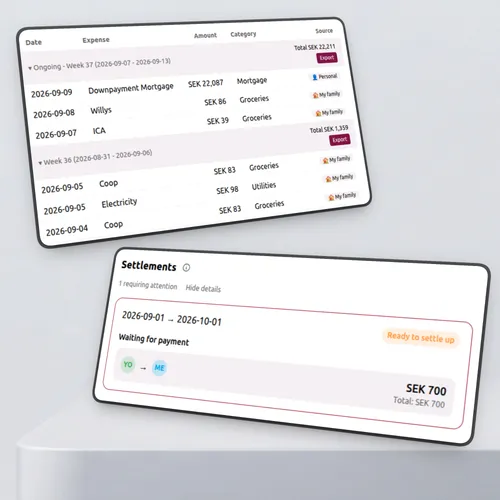
Records what the household actually spent and which partner paid.
The household balance
Compares agreed shares with actual payments so you can see whether anything needs to be settled.
What to record
Four questions every couples finance tracker should answer
Keep shared finances clear without tracking every personal purchase. Focus on what you spend together, how you contribute, and what needs to be settled.
What was the expense?
- Amount and date
- Category and purpose
- Optional notes
Who was it for?
- Shared or personal
- Who benefited from it
- Household category
Who paid?
- Partner who paid
- Amount actually paid
- Payment date
How do we split it?
- Equal, proportional, or custom shares
- Each partner’s agreed contribution
- Who owes what, if anything
The tracker becomes useful when payments are uneven
Suppose a couple agrees to share household expenses 60/40. During the month, the actual payments are different.
Shared household expenses
Payments recorded this month
Rent
Paid by Partner A
€1,500
Groceries
Paid by Partner B
€500
Utilities
Paid by Partner B
€250
Household supplies
Paid by Partner A
€150
Total recorded
4 shared expenses
€2,400
The tracker does not need to force the couple to transfer money after each purchase. It can keep the running picture visible until they choose to settle.
A practical household tracking workflow
Agree what is shared
Define the boundary before tracking begins.
Set the contribution rule
Choose how shared costs should be allocated.
Record expenses as they happen
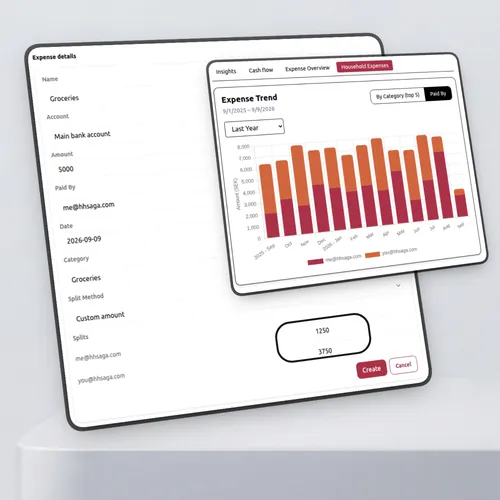
Capture the amount, category, and partner who paid.
Review the household picture
See spending, payments, and the current balance.
Settle on your schedule
Reconcile weekly, monthly, yearly, or whenever suits the household.
Keep personal money out
A couples tracker should not require tracking everything
The shared household can have its own financial picture. Personal spending, personal savings, and individual goals can remain outside it.
Shared visibility
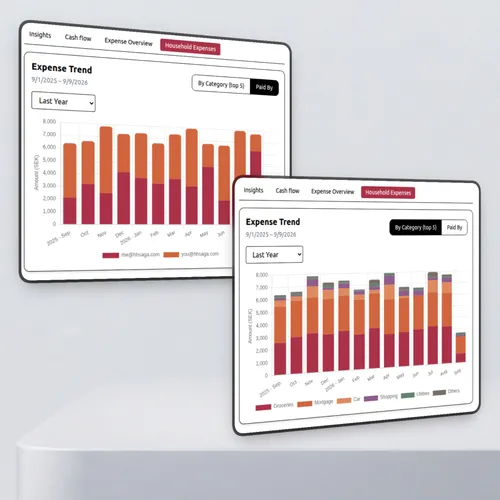
Both partners can see the household expenses and financial commitments they manage together.
Personal privacy
Personal purchases and accounts do not need to become household transactions.
One household balance
The couple can understand shared obligations without reconstructing the month from two sets of receipts and bank statements.
Use a different page for the decision before tracking
The tracker is the ongoing layer. These pages answer the questions that come before it.
FAQs
Couples Finance Tracker: Frequently Asked Questions
How to track shared expenses, keep separate bank accounts, agree on contributions, and understand what you owe each other.
What is a couples finance tracker?
A couples finance tracker helps you keep a clear record of shared household expenses, who paid each bill, and how the cost should be divided between you. Instead of relying on memory or scattered payment messages, you can see what each partner has contributed, whether one person has covered more than their agreed share, and what may need to be settled. It gives you a consistent view of your shared finances without requiring you to combine your bank accounts or track every personal purchase.
What is the difference between a couples finance tracker and a shared budget?
A shared budget sets out what you expect to spend, which household costs you plan to cover, and how much each partner intends to contribute. A finance tracker records what actually happens: the expenses paid, who covered them, and how the payments compare with your agreement. The two work best together. Your budget provides a plan, while your tracker helps you see whether you are following it and where adjustments may be needed.
How do you track shared expenses when you have separate bank accounts?
You can keep separate bank accounts and still maintain an accurate record of shared spending. Whenever one of you pays for a household expense, record the amount, date, category, who paid, and how the cost should be shared. Do the same for bills paid by the other partner. Compare those payments with your agreed contribution arrangement at a regular interval, such as the end of each month. This gives you a shared picture of household finances without needing a joint account.
What shared expenses should couples track?
Start with the expenses you have agreed to manage together. Common examples include rent or mortgage payments, electricity, internet, groceries, household supplies, insurance, childcare, transport, and shared subscriptions. You may also want to record irregular costs, such as repairs, annual bills, furniture, or family travel. Personal purchases do not automatically belong in the tracker. Agree on what counts as a shared expense so you both understand which payments affect your household balance.
How should couples divide shared expenses?
There is no single split that works for every household. You might divide costs equally, contribute in proportion to your incomes, agree on fixed monthly amounts, or use different arrangements for different expenses. The important thing is to decide how each cost should be shared before calculating what either person owes. A tracker can then compare the agreed shares with the amounts each partner has actually paid. That way, a difference in upfront payments does not automatically become a disagreement about fairness.
How do we calculate each partner’s share of shared expenses?
Start with the total expenses you have agreed to share, then apply your chosen contribution method. You might split the costs equally, divide them in proportion to your incomes, or use another arrangement that works for both of you. Once you know each partner’s expected share, compare it with what each person has actually paid. This helps you distinguish how much each partner should contribute from how much they have already covered.
How do we know who owes whom?
Start with the agreed sharing rule and calculate each partner’s responsibility for the expenses included in your arrangement. Then compare those amounts with what each person actually paid. If one partner paid more than their agreed share, the difference may be owed back to them; if they paid less, they may need to contribute more. Account for any payments or settlements already made before deciding what remains outstanding. The aim is to understand the net difference across your shared expenses, rather than treating every purchase as a separate debt.
How often should couples update their finance tracker?
Updating the tracker whenever a shared expense occurs makes it easier to keep the record accurate, especially when both partners pay bills throughout the month. You can then review the overall balance weekly or monthly, depending on how often you spend together and how frequently you prefer to settle up. A monthly review is a practical starting point for many households because it aligns with recurring bills and pay cycles. Choose a routine you can both maintain rather than making the process more complicated than it needs to be.
How often should couples settle shared expenses?
The right settlement schedule depends on your household and how you prefer to manage cash flow. Some couples settle monthly, while others use a shared account, transfer a fixed contribution regularly, or only settle when the difference becomes significant. Before choosing a schedule, agree on which expenses count, how contributions are calculated, and how previous settlements are recorded. Your tracker should reflect payments already made so you do not accidentally count the same amount twice.
Do both partners need to record every expense?
Not necessarily, but you both need to trust that the record is complete. One partner can enter expenses while the other checks the record, or you can each record the payments you make and review them together. Agree on a simple process for recording expenses, handling missing details, and correcting mistakes. If you use a shared spreadsheet or app, make sure both partners can access the information they need. The goal is a reliable shared record, not additional administrative work.
Can a couples finance tracker help prevent money arguments?
A tracker cannot resolve every disagreement about money, but it can reduce confusion about who paid, what was agreed, and whether a balance remains outstanding. Clear records are particularly helpful when partners have different incomes, pay bills at different times, or prefer different spending habits. They also make it easier to discuss an expense using the same information. For the tracker to help, both partners should agree on the sharing rules and feel comfortable raising questions when something does not look right.
Stop reconstructing the household at the end of the month
Keep shared expenses, payments, balances, and settlements in one household view with Household Saga.